New Delhi: In an increasingly turbulent world marked by geopolitical rivalries, regional conflicts, and economic uncertainties, India has steadily emerged as a credible voice for peace, dialogue, and cooperation. Over the past decade, the country has positioned itself as a responsible global actor capable of bridging divides between nations and advocating diplomatic solutions to complex international crises. From humanitarian assistance and peacekeeping missions to mediation efforts and global development initiatives, India’s growing stature as a peace messenger reflects both its civilizational ethos and its evolving geopolitical influence.
A Civilizational Foundation for Peace
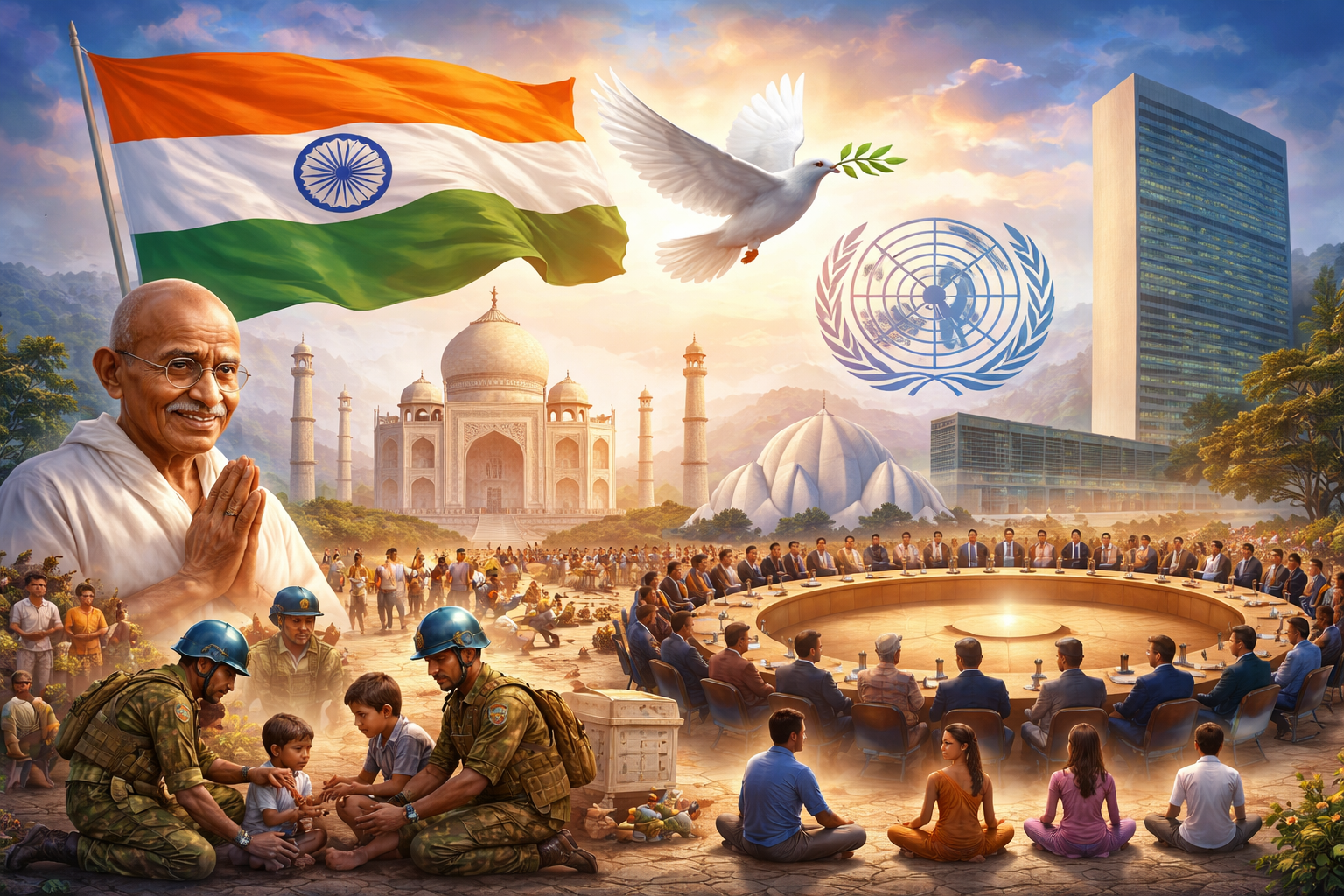
India’s commitment to peace is deeply rooted in its ancient philosophical traditions. The principles of “Vasudhaiva Kutumbakam”—the belief that the world is one family—and “Ahimsa” or non-violence have shaped India’s worldview for centuries. Leaders like Mahatma Gandhi championed non-violence as a powerful tool for conflict resolution, inspiring global movements for peace and justice.

After independence in 1947, India’s foreign policy reflected these ideals. Under the leadership of Jawaharlal Nehru, India played a key role in founding the Non-Aligned Movement, which aimed to maintain neutrality during the Cold War and promote peaceful coexistence among nations. India consistently advocated dialogue and diplomacy instead of military confrontation, establishing itself as a moral voice in international affairs.
Leadership in Global Forums
In recent years, India’s voice on the global stage has become stronger as its economic and strategic influence has grown. The country has actively used international platforms such as the United Nations, the G20, and the BRICS grouping to advocate cooperation, multilateralism, and peaceful resolution of disputes.
India’s presidency of the G20 in 2023 marked a significant moment in its diplomatic journey. Under the theme “One Earth, One Family, One Future,” the summit highlighted India’s vision of inclusive global development and shared responsibility. Despite deep divisions among major powers, India successfully facilitated a consensus declaration, demonstrating its ability to act as a bridge between the Global North and the Global South.
The summit also emphasized issues such as climate change, food security, sustainable development, and digital inclusion—areas where cooperation is essential for maintaining global stability.
Championing the Voice of the Global South
India has increasingly positioned itself as a champion of developing countries. Many nations in Asia, Africa, and Latin America view India as a partner that understands their challenges and aspirations. Through initiatives such as development partnerships, technology sharing, and humanitarian assistance, India has sought to strengthen solidarity among emerging economies.
The country has consistently called for reforms in global institutions like the United Nations Security Council to make them more representative and inclusive. By advocating a greater voice for developing nations, India has reinforced its image as a leader committed to fairness and global cooperation.
Humanitarian Assistance and Disaster Relief
Another major dimension of India’s peace diplomacy is its role in humanitarian assistance and disaster relief. The country has frequently responded to crises across the world with speed and efficiency.
For instance, during the COVID-19 pandemic, India launched Vaccine Maitri, supplying millions of vaccine doses and medical supplies to dozens of countries. This initiative strengthened India’s reputation as a responsible and compassionate global partner.
Similarly, India has carried out numerous evacuation and relief operations to assist people affected by conflicts and natural disasters. These missions not only help Indian citizens abroad but also support foreign nationals, reinforcing India’s image as a nation committed to human welfare.
Contributions to UN Peacekeeping
India has long been one of the largest contributors to United Nations Peacekeeping operations. Since the 1950s, more than 250,000 Indian troops have served in peacekeeping missions across the world, including in Africa, the Middle East, and Asia.
Indian peacekeepers have earned global respect for their professionalism, discipline, and humanitarian approach. Many have sacrificed their lives while serving under the UN flag, underscoring India’s commitment to maintaining international peace and security.
In recent years, India has also emphasized the importance of involving women in peacekeeping missions, reflecting its broader commitment to inclusive peacebuilding.
Mediation and Conflict Resolution
India has increasingly played a quiet but significant role in diplomatic mediation. While the country traditionally avoids overt intervention in other nations’ disputes, it often acts as a facilitator for dialogue.

For example, India has maintained diplomatic relations with a wide range of countries that are often at odds with one another. This ability to maintain balanced relationships allows India to act as a trusted interlocutor during crises.
In regions such as the Middle East, Southeast Asia, and Africa, India’s neutral stance and emphasis on dialogue have enhanced its credibility as a peace messenger.
Balancing Strategic Interests with Peace
India’s growing influence also comes from its ability to balance strategic partnerships with its commitment to peace. The country maintains strong ties with major powers such as the United States, Russia, and Japan, while also deepening engagement with developing nations.
This balanced diplomacy enables India to communicate with diverse geopolitical blocs and encourage dialogue during periods of tension.
At the same time, India continues to strengthen its own defense capabilities to ensure national security. By combining strategic strength with diplomatic engagement, India promotes a model of peace built on stability and mutual respect.
Cultural Diplomacy and Soft Power
India’s cultural heritage also plays an important role in its peace messaging. Practices such as yoga, Ayurveda, and meditation emphasize harmony between individuals, societies, and nature.
The global recognition of International Day of Yoga by the United Nations in 2014 illustrates how India’s cultural traditions contribute to global well-being. Celebrated in more than 180 countries, the event promotes physical and mental harmony, symbolizing India’s commitment to peaceful living.
India’s vibrant democracy, pluralistic society, and cultural diversity further enhance its soft power and strengthen its credibility as a nation that values coexistence and dialogue.
Challenges on the Path Ahead
Despite its growing influence, India faces several challenges in its role as a peace messenger. Regional tensions, global power rivalries, and economic inequalities continue to complicate international diplomacy.
Conflicts in regions such as Eastern Europe, West Asia, and the Indo-Pacific demand careful and balanced responses from major powers. As India’s global role expands, expectations from the international community will also increase.
To sustain its credibility, India must continue to promote dialogue, support multilateral institutions, and invest in humanitarian initiatives.
A Vision for the Future
India’s rise as a peace messenger reflects the convergence of its ancient values, democratic traditions, and modern diplomatic capabilities. As the world searches for cooperative solutions to global challenges—from climate change to geopolitical conflicts—India’s emphasis on dialogue, inclusivity, and shared prosperity offers a constructive path forward.
With its growing economic strength, youthful population, and expanding global partnerships, India is well positioned to play an even more significant role in shaping a peaceful and stable international order.
Ultimately, India’s message to the world is simple yet powerful: peace is not merely the absence of conflict, but the presence of justice, cooperation, and mutual respect. By championing these principles on the global stage, India continues to strengthen its identity as a trusted messenger of peace in an increasingly uncertain world.